Is a vapor barrier part of encapsulation?
Yes. A vapor barrier is usually one component of encapsulation, but encapsulation includes additional sealing and humidity-control decisions.
Compare repair scopes
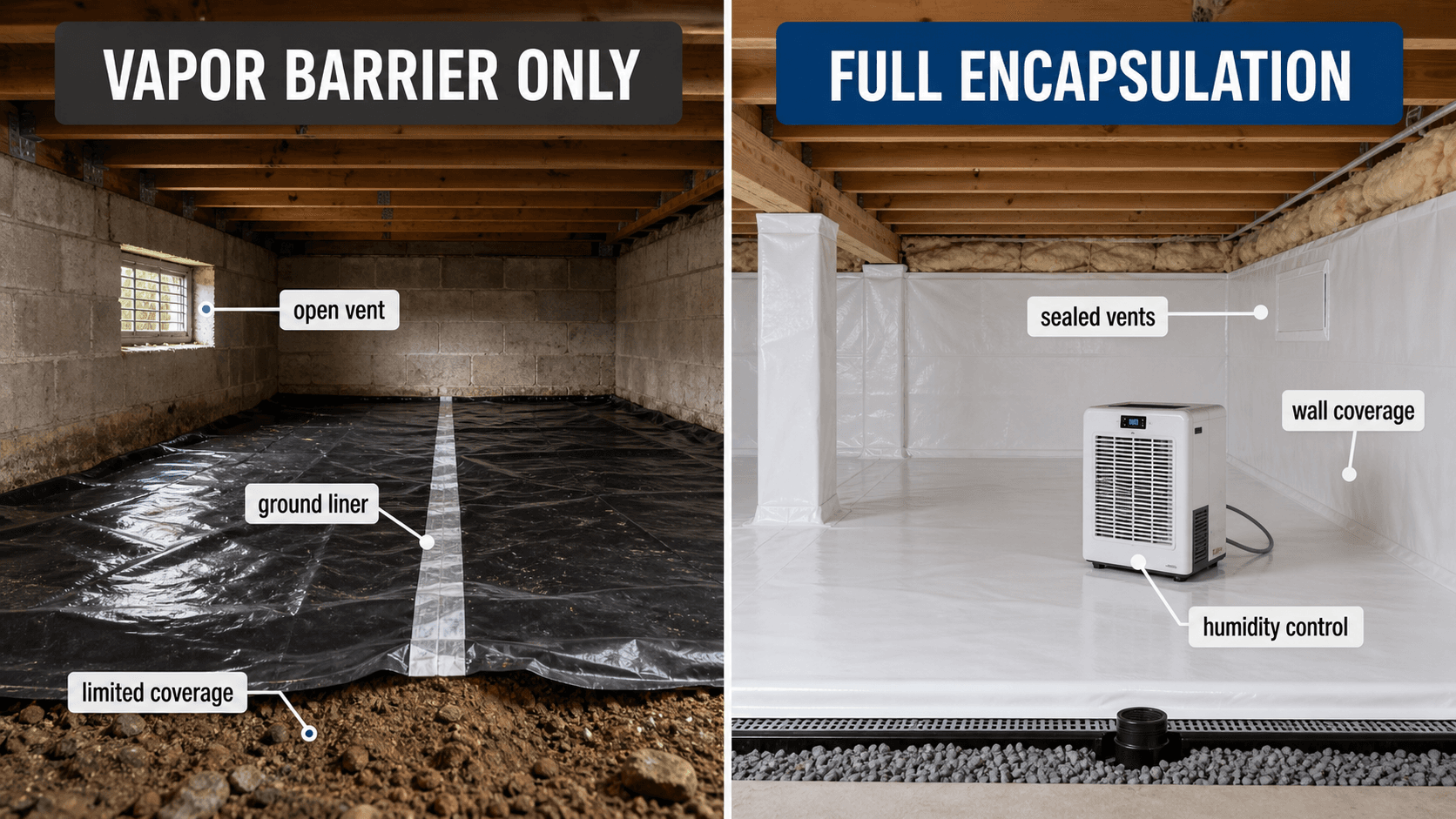
A vapor barrier and encapsulation are related, but they are not the same job. The right choice depends on whether the crawl space only needs exposed soil covered or needs a sealed, humidity-managed system.
Use this as a planning guide before comparing written contractor scopes.
Visual guide
Use this visual to orient the page before comparing the details in the sections below.
Watch
A short walkthrough of which scope actually fits your crawl space — and what must be fixed before sealing.
Quick comparison
Many quotes use the words loosely. Ask what will actually be installed.
| Question | Vapor barrier | Encapsulation |
|---|---|---|
| Main purpose | Reduce soil vapor | Seal and manage the crawl space |
| Coverage | Ground only or mostly ground | Ground, walls, piers, vents, seams, access, and penetrations |
| Humidity control | Passive | Usually active or mechanically managed |
| Water control | Does not fix standing water | Still requires drainage first when water is active |
| Best fit | Dry crawl space with exposed dirt | Humid, musty, damp, or repeatedly problematic crawl space |
When simpler is enough
The lower-cost option is not automatically wrong when the crawl space is genuinely dry.
No standing water or damp foundation wall pattern is present.
The framing looks dry and there is no persistent musty odor.
Humidity readings stay reasonable across humid months.
The main issue is exposed soil, dirt, or an old torn liner.
The quote clearly explains liner thickness, seam sealing, wall turn-up, and access durability.
When fuller scope matters
A ground liner cannot control every source of crawl space moisture.
Outdoor air enters through open foundation vents during humid weather.
Ducts, pipes, insulation, or framing show condensation patterns.
Musty odor moves into the home or appears after rain.
Foundation walls or piers contribute moisture.
The crawl space needs dehumidification, wall insulation, drainage, or sump work.
Quote check
Use these questions when two estimates use similar language but show very different prices.
Does the liner cover the floor only, or also walls and piers?
Are seams taped, sealed, or only overlapped?
Are foundation vents sealed permanently?
Is dehumidification included, excluded, or considered unnecessary?
What water, debris, insulation, or structural issues must be handled before installation?
Related guides
These supporting pages help you compare scope, humidity control, quote language, and warranty details without treating encapsulation as a one-size-fits-all package.
Weigh the real benefits and drawbacks and get a plain verdict on whether it is worth it.
Read guideCompare open foundation vents with a closed, humidity-managed crawl space.
Read guideSee how active drying, supply air, and exhaust approaches differ after sealing.
Read guideUse a homeowner checklist before approving a crawl space encapsulation quote.
Read guideUnderstand what should be written into material, workmanship, and equipment coverage.
Read guideFAQs
Short answers to common homeowner questions before comparing quotes.
Yes. A vapor barrier is usually one component of encapsulation, but encapsulation includes additional sealing and humidity-control decisions.
Often yes, if the first installation is compatible with a later upgrade. Ask whether the liner thickness, wall turn-up, seam sealing, and layout can support a sealed system.
A vapor barrier usually costs less because it has fewer components. Full encapsulation costs more because it addresses more moisture pathways and often includes humidity control.
Sources
These pages are educational planning guides. Use qualified professionals for site-specific structural, mold, electrical, HVAC, code, or health questions.