Basic vapor barrier
$2-$4/sq ft
Useful when the crawl space is dry and mainly needs exposed soil covered.
2026 Raleigh, Cary & Apex pricing guide
In the Triangle, crawl space encapsulation typically costs about $5,000-$15,000, with many complete projects around $7,500-$12,000. The final price depends on square footage, access, moisture severity, drainage, insulation, dehumidification, and repair needs.
Cost at a glance
The biggest mistake is comparing a simple ground liner to a full moisture-control system. These are different jobs with different costs.
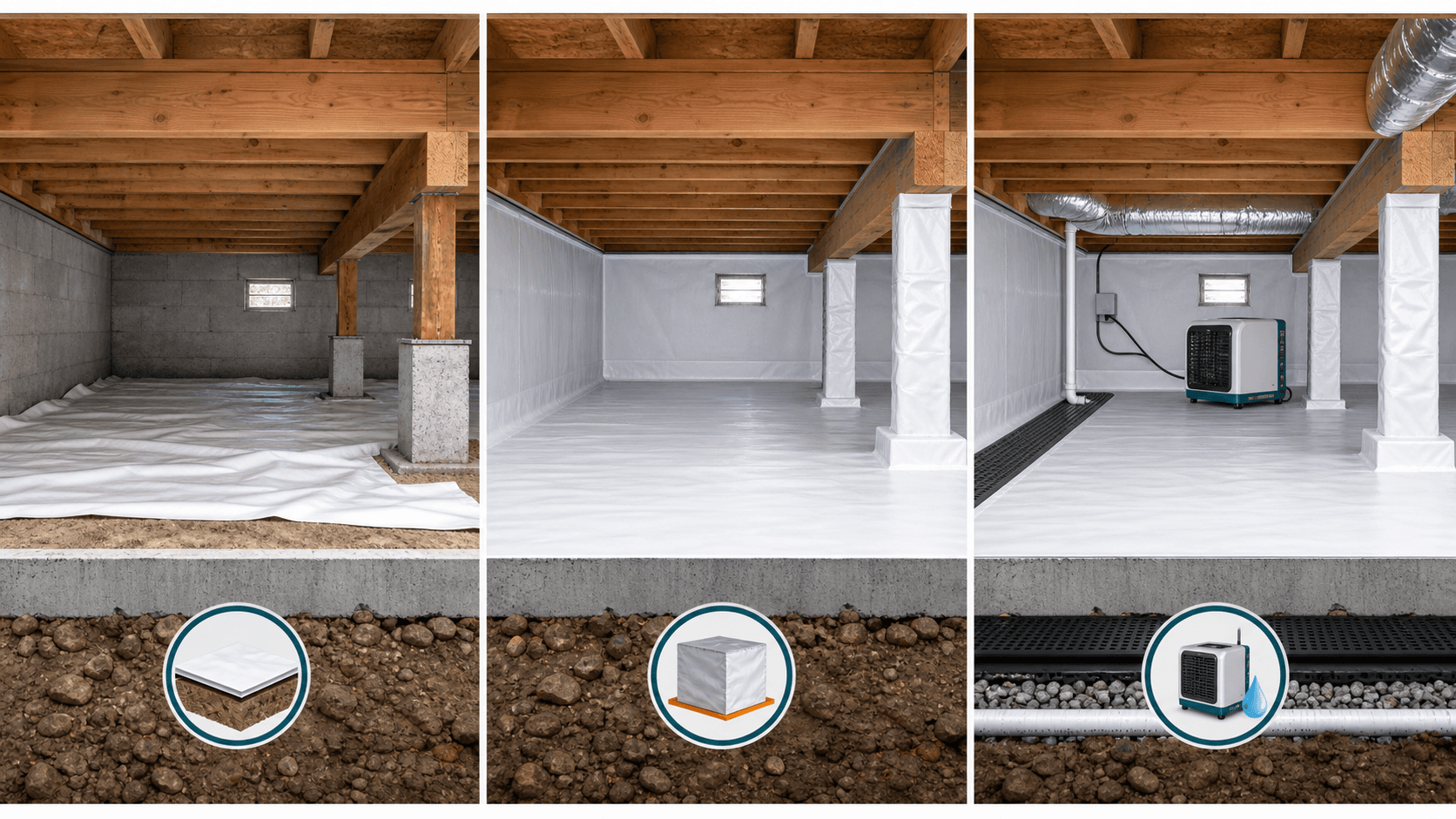
| Project scope | Typical cost | What is usually included | Best fit |
|---|---|---|---|
| Basic ground vapor barrier | $1,500-$4,000 | Floor liner, basic seam overlap or taping, limited wall coverage. | Dry crawl spaces with exposed soil and no active water problem. |
| Standard encapsulation | $5,000-$10,000 | Sealed floor liner, wall coverage, sealed seams, sealed vents, basic air sealing. | Musty, humid, or lightly damp crawl spaces. |
| Encapsulation with dehumidifier | $7,500-$15,000 | Standard encapsulation plus a crawl-space-rated dehumidifier and drainage for condensate. | Triangle homes with persistent humidity, duct condensation, or musty indoor odor. |
| Full moisture-control system | $12,000-$25,000+ | Encapsulation, dehumidifier, drainage, sump pump, insulation work, cleanup, or repairs. | Wet crawl spaces, standing water, mold-like growth, damaged insulation, or wood damage. |
Per square foot
The honest answer is a range by scope, not a single number. A simple ground liner and a full moisture-control system are priced very differently.
Basic vapor barrier
$2-$4/sq ft
Useful when the crawl space is dry and mainly needs exposed soil covered.
Standard encapsulation
$4-$8/sq ft
A better planning range for sealed floors, walls, seams, vents, and basic air sealing.
Full system
$8-$12+/sq ft
Applies when dehumidification, drainage, sump work, insulation, cleanup, or repairs are included.
Smaller crawl spaces often cost more per square foot because mobilization, access setup, equipment, disposal, and a dehumidifier do not shrink in direct proportion to square footage. A 600 sq ft crawl space can have a higher per-foot price than a 2,000 sq ft crawl space even when the scope is similar.
Local pricing
Use these Triangle planning ranges to sanity-check quotes. Dry means no active water or major cleanup. Damp means musty odor, elevated humidity, or light moisture. Problem crawl means standing water, mold-like growth, damaged insulation, drainage needs, or wood repair concerns.
| Crawl space size | Dry or simple | Damp or humid | Wet or repair-heavy |
|---|---|---|---|
| 500 sq ft | $2,500-$4,500 | $3,500-$6,500 | $6,000-$11,000+ |
| 1,000 sq ft | $4,000-$7,000 | $5,500-$9,000 | $8,500-$15,000+ |
| 1,500 sq ft | $5,500-$8,500 | $7,500-$12,000 | $10,000-$20,000+ |
| 2,000 sq ft | $7,000-$11,000 | $9,000-$15,000 | $13,000-$25,000+ |
| 2,500 sq ft | $8,500-$14,000 | $11,000-$18,000 | $16,000-$30,000+ |
Scope
A strong quote should describe the system, not hide everything under one vague line item.
Heavy-duty vapor barrier over exposed soil
Sealed seams with compatible tape
Wall coverage and secure attachment
Wrapped or sealed piers where appropriate
Sealed foundation vents and obvious air leaks
Dehumidifier or other approved moisture-control method
Condensate drain path for the dehumidifier
Drainage or sump pump plan if water enters the crawl space
Insulation removal or replacement when needed
Components
These ranges explain why two encapsulation quotes can look wildly different even for the same house.
| Component | Typical installed cost |
|---|---|
| Vapor barrier material and installation | $1,500-$4,500 |
| Seam tape, fasteners, wall attachment, and pier sealing | $500-$2,000 |
| Vent sealing and air sealing | $300-$1,500 |
| Crawl-space-rated dehumidifier installed | $1,200-$3,500 |
| Interior drainage system | $2,000-$6,000 |
| Sump pump installation | $800-$2,500 |
| Old insulation removal | $1,000-$4,000 |
| Wall or rim insulation | $1,500-$5,000 |
| Mold-like growth cleaning or treatment | $1,500-$6,000+ |
| Structural wood repair | $2,500-$15,000+ |
Triangle context
Local conditions matter. The Triangle is humid, many homes have vented crawl spaces, and many crawl spaces contain HVAC ducts, old insulation, or signs of seasonal water entry.
Raleigh, Cary, Apex, Durham, and Chapel Hill sit in a humid climate where outdoor summer air can carry enough moisture to create condensation risk on cooler crawl space surfaces. NOAA climate normals are the right source for verified local climate context, and city-specific pages should cite those values when published.
Triangle homeowners often compare quotes that include different things: one may include a dehumidifier and old insulation removal, while another may only include a floor liner. Before comparing price, compare scope.
Decision guide
A cheaper vapor barrier can be enough in some crawl spaces. In others, it is only one piece of the system.
| What you see | Likely first step | Cost category |
|---|---|---|
| Bare dirt, dry framing, no odor | Ground vapor barrier may be enough | Lower cost |
| Musty odor or high humidity | Evaluate sealing and dehumidification | Standard to full encapsulation |
| Condensation on ducts | Assess humidity, duct insulation, and dehumidifier need | Full system likely |
| Standing water after rain | Fix drainage, grading, or sump needs first | Water-control work before encapsulation |
| Sagging floors or rotted joists | Get structural evaluation before cosmetic sealing | Repair scope added |
| Mold-like growth | Correct moisture source and use qualified assessment language | May require separate remediation |
Before you seal
A good contractor should slow down when the crawl space has active problems that need to be fixed before the liner goes in.
Active standing water or repeated water entry after rain.
Plumbing leaks, HVAC condensation issues, or bulk water from the exterior.
Damaged joists, beams, sill plates, posts, or subflooring.
Pest damage or debris that needs removal before sealing.
Missing downspout extensions or grading that sends water toward the foundation.
Electrical outlet, sump pump, or dehumidifier work that needs proper permitting or licensed trade review.
Permits and code
This is not legal or code advice. It is a homeowner-friendly prompt for the right contractor questions.
North Carolina guidance says a permit can be required when a conventional vented crawl space is converted to a closed crawl space, especially when the work changes humidity-control equipment, HVAC, electrical, or related systems. Raleigh homeowners should confirm requirements with the local building department or require the contractor to state who handles permits.
Quote review
This checklist is one of the highest-value parts of the page because it helps homeowners compare scope, not just totals.
Vapor barrier thickness is listed, ideally 12-20 mil for full encapsulation.
The quote states whether walls and piers are covered, not only the floor.
Seam taping, wall fastening, and vent sealing are specifically included.
The dehumidifier model, capacity, drain method, and warranty are listed.
Drainage and sump pump work are either included or clearly excluded.
Old insulation removal and replacement are separated from encapsulation.
Mold-like growth, pest damage, or wood rot language is specific and careful.
Permit responsibility is stated when the scope changes ventilation, HVAC, electrical, or moisture-control design.
The warranty explains what is covered, who honors it, and what maintenance is required.
The contractor explains what should be fixed before encapsulation begins.
Related encapsulation guides
Use these guides to decide whether a quote is a simple liner, a sealed crawl space, or a full moisture-control project.
Red flags
A low quote is not automatically bad, and a high quote is not automatically padded. The problem is when the scope cannot be understood.
One-line pricing such as "encapsulation system" with no material or scope detail.
No vapor barrier thickness listed.
No discussion of dehumidification in a humid or sealed crawl space.
No drainage plan even though standing water is present.
No mention of old insulation, debris, or access constraints.
No written warranty details or maintenance requirements.
Health, mold, or structural claims that go beyond the contractor's qualifications.
Pressure to sign before you can compare written quotes.
No answer about permits when the scope involves moisture-control equipment.
FAQs
These questions target common long-tail searches while keeping the answers useful.
As a national planning range, a complete crawl space encapsulation usually lands somewhere around $5,000-$15,000, or roughly $4-$8 per square foot for standard work. The average crawl space encapsulation cost tends to sit near the middle of that band for a dry, average-sized space, while wet or repair-heavy crawl spaces run higher because drainage, rot, or mold work has to happen first. Treat these as planning ranges for budgeting rather than a quote - the real cost to encapsulate your crawl space depends on its size, its condition, and what has to be corrected before sealing.
Most complete crawl space encapsulation projects in Raleigh, Cary, Apex, and nearby Triangle cities fall around $5,000-$15,000. A 1,500 sq ft damp crawl space often lands near $7,500-$12,000, while wet or repair-heavy spaces can cost more.
A practical planning range is about $2-$4 per square foot for a basic vapor barrier, $4-$8 per square foot for standard encapsulation, and $8-$12+ per square foot for full systems with dehumidification, drainage, insulation, or remediation.
Yes. A basic vapor barrier is usually much cheaper because it mainly addresses ground moisture. Full encapsulation costs more because it seals the floor, walls, seams, vents, and often adds mechanical drying.
Many Triangle crawl spaces need one, especially when humidity, musty odor, HVAC duct condensation, or sealed vents are part of the situation. The right answer depends on measured humidity, crawl space tightness, and the moisture source.
Yes. Encapsulation should not be treated as the first fix for active water intrusion. Drainage, grading, downspouts, plumbing leaks, or sump pump needs should be addressed before sealing the crawl space.
It can, depending on the scope. North Carolina guidance says converting a conventional vented crawl space to a closed crawl space can require a permit when the work changes moisture-control systems, electrical, HVAC, or related equipment. Confirm with Raleigh or your local building department before work begins.
Sources
The numbers on this page are planning ranges compiled from published cost guides, local contractor ranges, official climate and code sources, and homeowner quote-comparison logic. They should be updated as real Triangle quote data is collected.
Last reviewed: July 29, 2026. Pricing version: initial editorial planning range v0.1.