CrawlSpace Guide
Crawl space comparison showing a dehumidifier removing moisture and ventilation moving air

Crawl space humidity-control guide

Crawl Space Dehumidifier vs. Ventilation

A dehumidifier removes water vapor and controls to a humidity setting. Ventilation moves air, so its result depends on whether replacement air is drier or wetter. In a humid climate, a sealed crawl space with direct dehumidification is often the more predictable approach, but exhaust, house air, or HVAC supply can also work when deliberately designed and verified.

Method comparison

Ventilation is not one method

Open vents, exhaust, house air, and HVAC supply move different air through different pressure paths. Compare each one separately with direct dehumidification.

MethodWhat it doesWhere it may fitWhat the quote must address
Open foundation ventsExchanges crawl-space air with outdoor airA code-compliant vented crawl space in a climate and building design suited to outdoor ventilationCan add moisture when outdoor air is humid; provides no measured humidity setpoint
Exhaust ventilationPulls crawl-space air outdoors and creates replacement-air flowA designed closed-crawl method with a known makeup-air path and verified airflowPressure effects, continuous fan operation, energy use, and the source of replacement air
House-air supply fanMoves indoor house air into the closed crawl spaceA designed system with a relief path, continuous-duty equipment, and code reviewAirflow balance, pressure, filtration, and whether the house air is actually dry enough
HVAC supply airUses conditioned supply air from the home systemA closed crawl space integrated deliberately with HVAC designSeasonal runtime, backflow protection, air balance, equipment sizing, and trade licensing
Crawl-space dehumidifierCondenses water vapor and drains the collected water awayA sealed or encapsulated crawl space needing direct, measurable humidity controlCapacity at crawl-space temperature, power, condensate drainage, airflow, filter access, and maintenance

Visual comparison

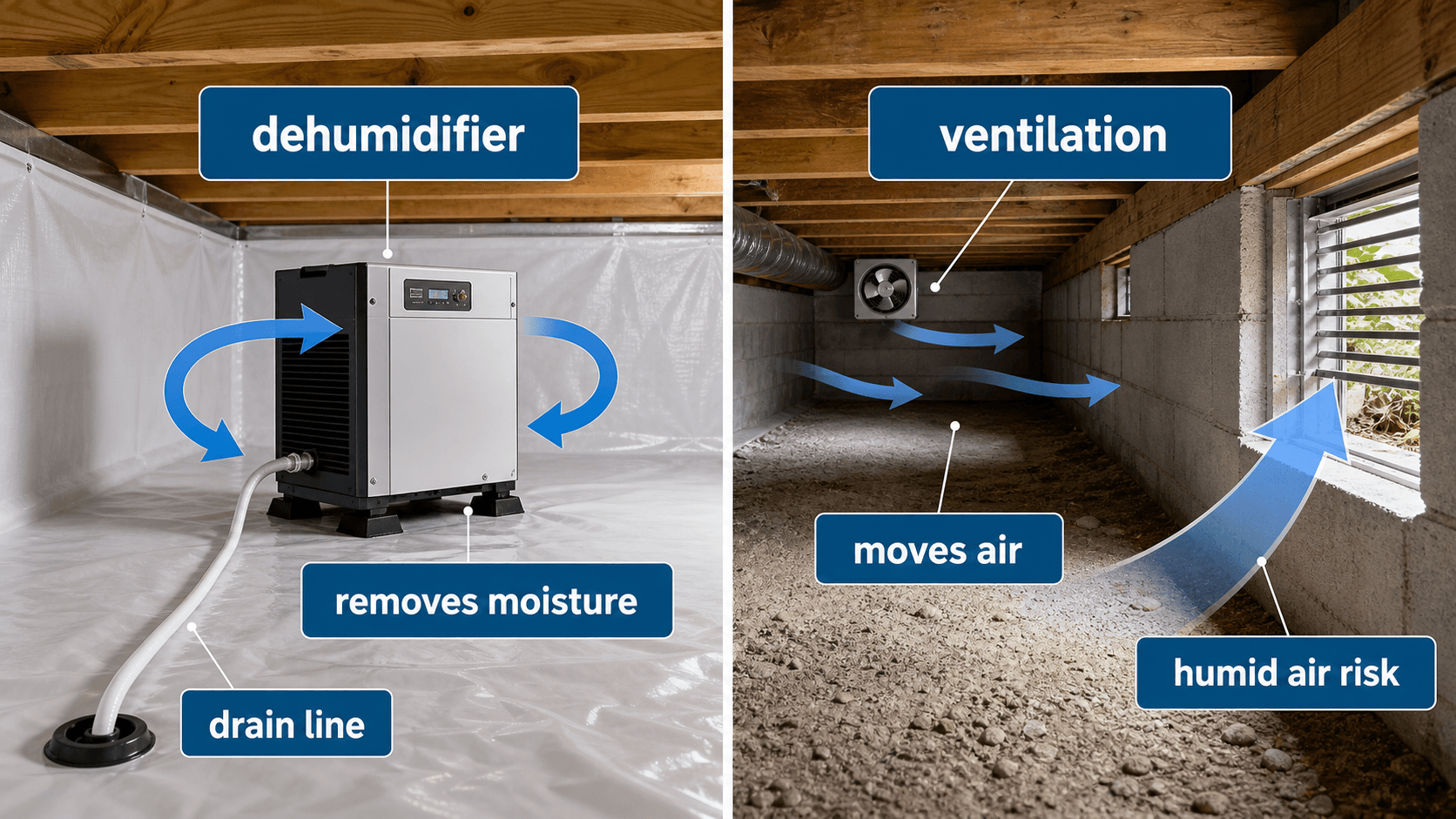
Removing moisture is different from moving air

A dehumidifier condenses water vapor and sends liquid condensate to a drain. Ventilation changes the air in the space, but it only dries when the replacement air creates a lower moisture load.

Side-by-side crawl space comparison showing a dehumidifier with drain line versus ventilation with humid outdoor air risk
The right comparison is moisture removal versus a documented air-exchange path, not simply an appliance versus a fan.

Why vents can backfire

Outdoor relative humidity does not tell you whether outdoor air will dry the crawl space

Warm air can carry much more water vapor than cool air. When humid outdoor air enters a cooler crawl space, its relative humidity rises and condensation can form on cooler ducts, pipes, framing, or insulation.

Use dew point to compare air sources.

Relative humidity changes with temperature. Dew point is a better clue to the actual moisture content of the air. If outdoor dew point is above the temperature of crawl-space surfaces, bringing in more outdoor air can move those surfaces closer to condensation.

Air movement still matters after air is dry.

A long crawl space, divided foundation, or blocked bay can have damp pockets even when one sensor looks good. A circulation fan or ducted dehumidifier can distribute dry air, but circulation alone does not remove moisture from the enclosure.

Decision table

Which humidity-control approach should you compare first?

Start with the symptom and enclosure, not the cheapest piece of equipment. Final design should reflect measured conditions, the house air system, and local requirements.

What you observeCompare firstWhy
Humidity rises during warm, muggy weather while foundation vents are openReview sealing plus active humidity controlMore outdoor-air exchange may add moisture rather than remove it.
The crawl space is encapsulated and stays above the target humidityDehumidifier sizing, airflow, drainage, and seal reviewA sealed space still needs a working moisture-control method and low source load.
A closed crawl quote specifies exhaust ventilation and a makeup-air pathQualified design and airflow verificationExhaust can be valid, but the quote should explain pressure, replacement air, runtime, and testing.
A quote adds HVAC supply air to the crawl spaceHVAC load, balance, damper, and seasonal reviewThe system must work when cooling or heating runtime changes and should not create unwanted return airflow.
Only air circulation is poor, but humidity is already controlledCirculation fan or ducted dehumidifier layoutMoving dry air between isolated areas can help without becoming the main moisture-control method.
Standing water, wet walls, or active leaks are presentWater-source and drainage repair firstNeither a fan nor a dehumidifier should be expected to solve recurring liquid water.
Bare soil or a torn ground liner is the main moisture sourceGround vapor control firstEquipment will run harder and longer while soil vapor is freely entering the space.
The crawl space is in a flood-prone design that must remain ventedSite-specific flood, code, and moisture planningFlood openings and ordinary moisture vents are not interchangeable; do not seal required openings casually.

Correct sequence

Humidity equipment comes after source control

A fan or dehumidifier should finish a moisture-control system, not compensate forever for water, exposed soil, or an undefined crawl-space enclosure.

  1. 1

    Stop liquid water

    Repair plumbing or HVAC leaks, roof-runoff problems, wall seepage, standing water, and drainage defects before selecting air equipment.

  2. 2

    Reduce ground vapor

    Cover exposed soil with a continuous ground liner appropriate to the crawl-space design, with seams and penetrations handled correctly.

  3. 3

    Define the enclosure

    Decide whether the crawl space remains vented or becomes closed. Do not mix open vents with an undersized dehumidifier and call it a finished system.

  4. 4

    Choose one documented control method

    Specify dehumidification, exhaust, house air, HVAC supply, or another approved method with equipment, airflow, drainage, and responsibilities in writing.

  5. 5

    Commission and monitor

    Verify airflow or drainage, record RH in more than one area, inspect after heavy rain and humid weather, and correct problems revealed by the trend.

Troubleshooting

What system behavior says about the weak link

High humidity does not automatically mean the equipment is too small. The source, enclosure, air path, distribution, drainage, and controls may be the real problem.

What happensLikely weak linkWhat to investigate
A vent fan runs, but RH climbs on humid daysReplacement air may be wetter than crawl-space airCompare indoor, crawl-space, and outdoor dew point instead of outdoor RH alone.
A dehumidifier runs almost continuouslyHigh source load, undersizing, poor circulation, or air leakageCheck ground cover, open vents, standing water, condensate flow, filter, temperature, and unit capacity.
One area is dry while a remote bay stays dampAir distribution problemReview blocked pathways, foundation divisions, ducting, and equipment placement.
Humidity is acceptable only when the HVAC runsSupply-air method is too dependent on seasonal runtimeVerify the intended year-round control strategy with an HVAC professional.
Musty odor continues even after RH improvesWet materials, debris, hidden water, or residual contaminationInspect safely for damp insulation, wood, liner puddles, leaks, and cleanup needs.
Water collects near the dehumidifierCondensate drain or pump failureStop relying on the unit until its drain route and electrical conditions are safe and functional.
Floors or doors change after crawl-space pressure changesAir-balance or building-pressure effectHave the ventilation and HVAC design checked rather than increasing fan speed.

Operating tradeoffs

Compare more than purchase price

Fans often use less direct equipment power, while dehumidifiers provide a clearer humidity setpoint. The full energy and maintenance cost depends on replacement air, HVAC load, sealing, drainage, and runtime.

FactorDehumidifierVentilation or conditioned-air method
Control variableMeasured crawl-space humidityAirflow and the moisture content of replacement air
Weather dependenceLower once the crawl space is sealed, though moisture load still changesHigh; performance changes when incoming air becomes warmer or wetter
Water producedYes; requires continuous condensate disposalNo condensate, but moisture is moved with the air rather than condensed
Main energy useCompressor and fan while dehumidifyingFan power plus possible heating or cooling of replacement air
Routine checksFilter, coil condition, drain, pump, controller, airflow, and RH trendFan, screen, duct or grille, airflow, controls, pressure path, and RH trend
Common hidden costPoor sealing or water control makes the unit run excessivelyConditioned house air may be exhausted or outdoor air may add HVAC load
Best proof it worksStable RH trend plus reliable condensate drainageVerified airflow, known replacement-air path, and stable RH across weather changes

North Carolina planning

Closed crawl spaces need a documented moisture-control method

North Carolina's published OSFM interpretation illustrates why method selection affects scope, trades, and permit conversations. It is not enough for a quote to say only 'seal the vents.'

Four methods are documented.

The OSFM interpretation describes dehumidifier, supply-air, house-air, and exhaust-fan methods under its cited 2012 residential code provisions. Combination systems were also contemplated.

Trade responsibilities can differ.

HVAC supply work, fans, condensate routing, outlets, and controls can cross mechanical, electrical, plumbing, or general contracting boundaries. The quote should assign each part.

Confirm the current rules locally.

Code editions and local enforcement change. Ask the authority having jurisdiction and qualified trades what applies to the current home and proposed scope before work begins.

Quote review

Questions that expose an incomplete humidity-control proposal

A useful proposal names the enclosure, moisture source, method, equipment or airflow, drain and pressure paths, commissioning result, maintenance, and professional responsibilities.

Is the crawl space staying vented or being converted to a closed crawl space?

Which moisture-control method is proposed, and which code or design requirement does it satisfy?

What measured humidity, temperature, water entry, or condensation evidence supports this method?

What must be repaired before the fan, duct, or dehumidifier is installed?

For ventilation, where does replacement air come from and where does exhausted or relief air go?

For HVAC or house air, how will airflow and pressure be balanced and verified across seasons?

For a dehumidifier, what is the model, rated capacity, operating-temperature range, and humidity setting?

How will condensate drain continuously, and what happens if the drain or condensate pump fails?

How will air reach divided bays or remote areas of the crawl space?

What electrical, HVAC, permit, and licensing work is included or assigned to another trade?

What readings will be recorded at commissioning, and what result triggers a return visit?

Which filters, drains, fans, alarms, and controls need service, and who owns that maintenance?

Safety boundaries

Know when this needs professional design or inspection

Changing crawl-space pressure, HVAC airflow, combustion conditions, wiring, or moisture-control equipment can affect more than humidity.

Do not enter standing water near wiring, outlets, HVAC equipment, fans, pumps, or dehumidifier controls.

Have natural-draft combustion equipment evaluated when enclosure or pressure changes could affect venting or backdraft risk.

Do not connect crawl-space return air to the home HVAC system casually; contaminated or damp air can be drawn into the living space.

Do not seal openings required for flood protection or other site-specific conditions without qualified review.

Treat structural decay, widespread mold-like growth, sewage, chemicals, and pest contamination as separate professional boundaries.

Use qualified trades for electrical circuits, HVAC modifications, condensate plumbing, permit work, and commissioning where required.

Verification

Measure the result instead of trusting the equipment label

Commission the method, then monitor it through humid weather and rain. A single sensor beside the equipment is not enough for a divided or irregular crawl space.

Track more than one location

Compare readings near the access, in a remote bay, and near cool ducts or plumbing. Record weather and recent rain with each trend.

Verify moisture leaves

Confirm dehumidifier condensate reaches its outlet or that ventilation airflow reaches the designed rate and follows the intended pressure path.

Inspect after the hard days

Check after heavy rain, peak summer humidity, outages, filter changes, and equipment alarms. These events reveal weak links that a dry-day walkthrough may miss.

Next steps

Connect the equipment choice to the whole moisture system

Humidity control works only after water, ground vapor, air sealing, distribution, drainage, and maintenance are understood.

FAQs

Crawl space dehumidifier and ventilation questions

Plain answers for homeowners comparing fans, vents, conditioned air, and active dehumidification.

Is a dehumidifier better than a fan for a crawl space?

A dehumidifier provides more direct and measurable humidity control because it removes water vapor from the air. A fan only moves or exchanges air, so its result depends on where replacement air comes from and how much moisture that air carries. Either method still requires liquid water and ground vapor to be addressed.

Will a ventilation fan lower crawl space humidity?

It can when the system is designed with an appropriate replacement-air path and the incoming air is dry enough. It can also raise humidity when it pulls in warm, moisture-laden outdoor air. Verify performance with humidity and dew-point trends rather than assuming airflow equals drying.

Should crawl space vents be open when using a dehumidifier?

Usually not when the dehumidifier is intended to control a sealed or encapsulated crawl space. Open vents can add a continuous outdoor moisture load. Do not close vents casually, though; first address water, ground vapor, combustion, flood openings, insulation, and local closed-crawl requirements.

Does every encapsulated crawl space need a dehumidifier?

Not every closed crawl space uses the same method. Some designs use dehumidification, conditioned supply air, house air, or exhaust ventilation. The proposal should identify the method, explain why it fits the house, and state how performance will be verified.

Can I use both an exhaust fan and a dehumidifier?

Combination systems are possible, but more equipment is not automatically better. Exhaust changes pressure and replacement-air flow while a dehumidifier removes moisture. The designer should explain what each component does, how they interact, and why both are needed.

Can a circulation fan replace a dehumidifier?

No. A circulation fan can reduce stagnant pockets and help dry air reach remote areas, but it does not remove water vapor from the crawl space. It is a distribution tool, not a humidity-control method by itself.

What humidity should an encapsulated crawl space maintain?

A practical target for many controlled crawl spaces is roughly 45% to 55% relative humidity, with sustained readings above 60% prompting investigation. Readings should be interpreted with temperature, weather, visible water, wood moisture, and condensation clues.

Does a dehumidifier fix standing water in a crawl space?

No. A dehumidifier removes water vapor from air. Standing water requires source correction, drainage, pumping, leak repair, grading, or runoff management before humidity equipment can work efficiently.

Sources

Research notes and review date

These references support the method comparison, setup sequence, North Carolina boundaries, and equipment questions.

Last reviewed: August 20, 2026. This guide is educational and is not an HVAC design, electrical plan, code determination, mold assessment, or inspection of your home.

Not sure this is the right fix?

A person reads every one of these and writes back — usually within a couple of days. Your email doesn't go to anyone else.