Crawl Space Sump Pump Battery Backup: Do You Need One?
A backup is most valuable when your sump receives water during storms, the basin can rise quickly, an outage could damage materials or equipment, or nobody can reach the crawl space quickly.
Who should seriously consider a sump pump battery backup?
The decision is about risk, not a blanket rule. Use actual water behavior, outage exposure, access, and consequences.
What you observe
Backup priority
Why it changes the decision
The primary pump runs often during heavy rain
High priority
The basin may rise quickly if the pump loses power or its switch fails.
Past outages have occurred during wet weather
High priority
The same storm can increase water inflow and interrupt the power the primary pump needs.
Water reaches insulation, framing, ducts, or equipment if the basin overflows
High priority
Even a short outage may create an expensive cleanup or repair problem.
The crawl space is difficult to enter or is rarely checked
Medium to high priority
Automatic pumping and an alarm matter more when nobody can respond quickly.
The pump runs only after unusual storms and the basin rises slowly
Medium priority
An alarm plus a properly sized backup may still be worthwhile, but the urgency is lower.
The basin is normally dry and there is no history of water collection
Lower priority
First confirm why the sump exists and whether drainage ever sends water to it.
There is humidity but no liquid water or sump basin
Not the right solution
Evaluate ground vapor, vents, leaks, and humidity control instead of adding a pump backup.
How it works
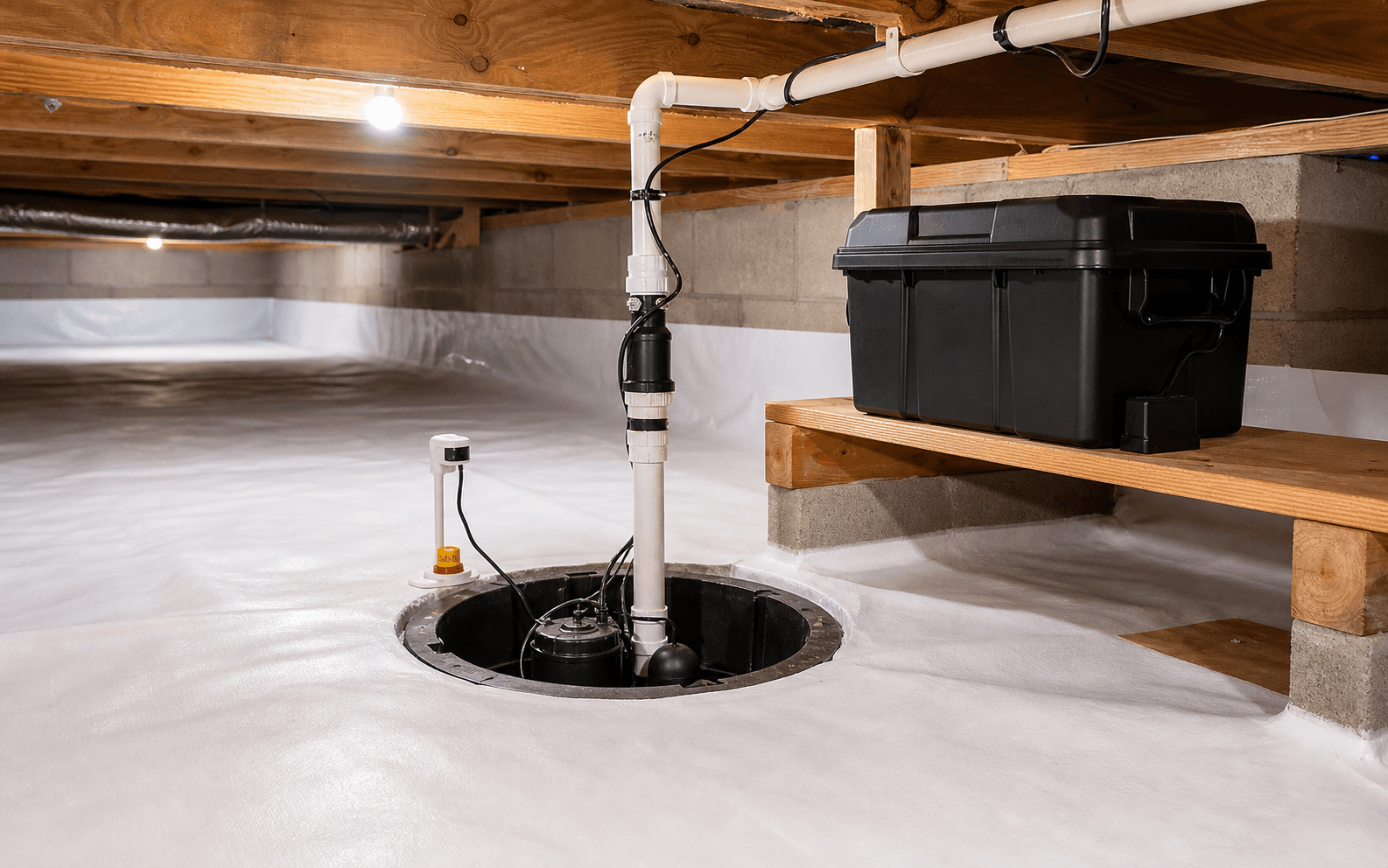
A real backup is more than a battery beside the basin
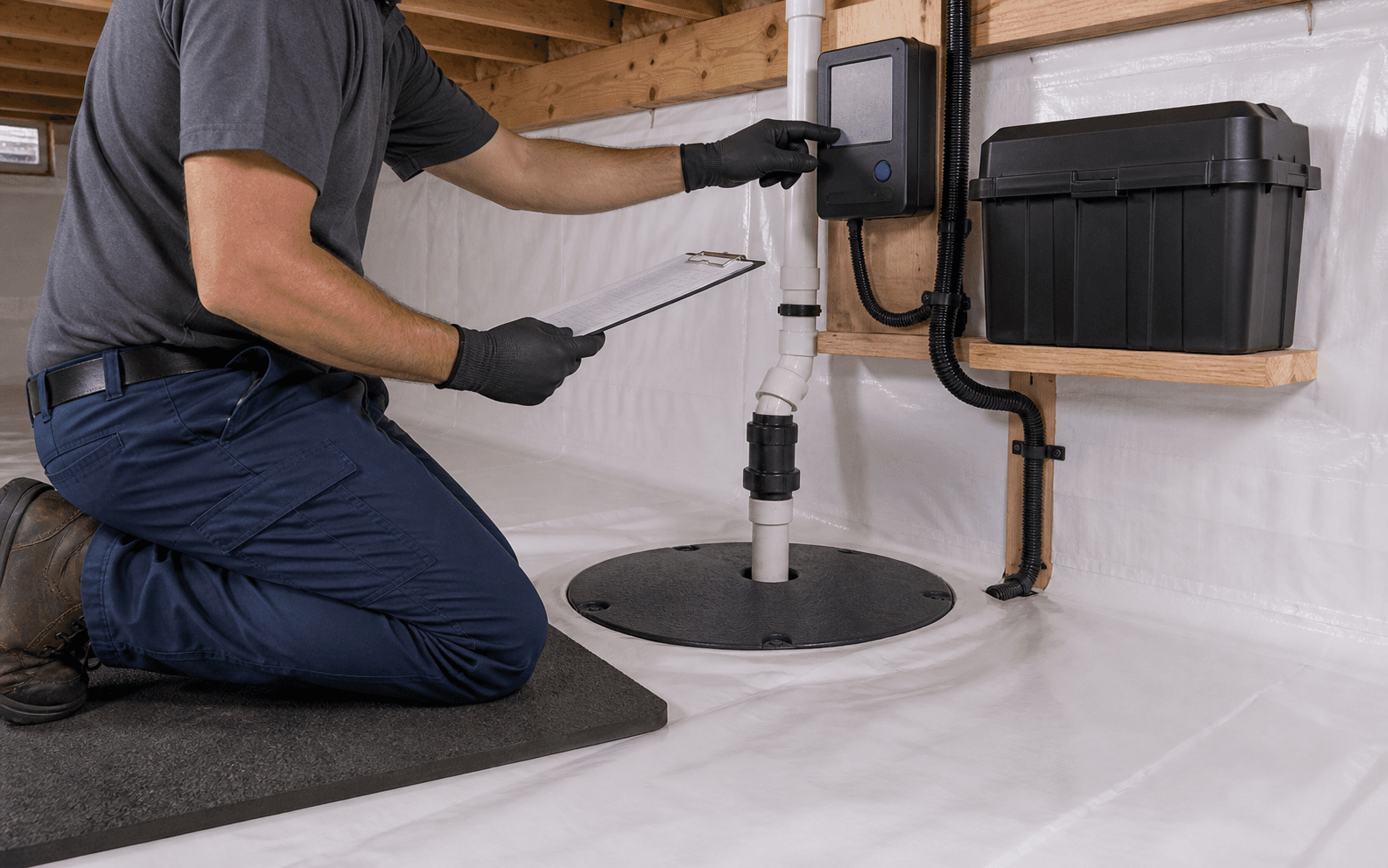
A common system uses a separate low-voltage pump, its own float switch, a compatible deep-cycle battery, a charger/controller, and an alarm.
The backup waits above the primary pump.
The backup float is normally set higher than the primary float. If water rises because the main pump has no power, fails to start, or cannot keep up, the higher float activates the backup. The controller should also report that the backup has run, because activation means the main system needs attention.
Independence determines what it protects against.
A separate pump, float, and stored power source provide more layers than a battery connected only to the primary pump. But shared parts still matter. If both pumps use one blocked discharge or a failed check valve, adding a second motor may not keep the crawl space dry.
Failure modes
What a battery backup can and cannot protect against
Before buying equipment, name the failure you are trying to survive. Different backup designs cover different weak points.
Failure
Will backup help?
Important limitation
Utility outage or tripped circuit
Yes, if the backup has independent stored power
Confirm the charger, battery, controller, and backup pump are all working.
Primary pump motor or float-switch failure
Usually, with a separate backup pump and float
An inverter that only powers the same failed primary pump may not provide mechanical redundancy.
Water arrives faster than the primary pump can remove it
Sometimes
The backup must add enough capacity at the actual discharge height; a small backup can still be overwhelmed.
Blocked or frozen shared discharge line
Often no
Two pumps using the same blocked path may both fail to move water away.
Failed check valve or water flowing back into the basin
Not by itself
The valve and discharge layout must be corrected so the system is not repeatedly pumping the same water.
Water never reaches the sump basin
No
Drainage collection must route water to the basin before any pump can remove it.
Compare options
Battery backup vs generator, inverter, second pump, and alarm
No option is automatically best. The right system depends on outage length, pump capacity, water supply, basin space, maintenance, and which failures must be covered.
Option
Best protection
Strength
Watch-outs
Separate 12-volt backup pump
Power outage plus primary-pump or primary-float failure
Automatic, common, and mechanically separate from the primary pump
Usually lower flow than the primary; battery and charger require testing
Battery inverter for the primary pump
Short outages when maintaining primary-pump capacity matters
Can run the existing AC pump when properly matched
Does not help if that pump or its float has failed; starting surge and compatibility matter
Second AC pump plus standby generator
Longer outages and homes already planning whole-home backup
Can provide strong capacity and pump redundancy
Higher cost and maintenance; installation and circuits require qualified planning
Water-powered backup
Some municipal-water homes where allowed
Does not rely on household electricity or a stored battery
Uses potable water and requires adequate pressure, backflow protection, approved plumbing, and local acceptance
High-water alarm only
Low-risk basins where someone can respond quickly
Simple warning layer and useful addition to any pump system
Warns you but does not remove water
Generator connections, new circuits, inverters, water-powered pumps, and backflow devices can cross electrical and plumbing boundaries. Use manufacturer-approved equipment and qualified trades where the work requires them. Never run a portable generator inside a home, garage, or crawl space.
Capacity and runtime
Do not choose a backup by horsepower or advertised hours alone
A useful backup must move water at your real discharge height and continue long enough for your likely outage and inflow pattern.
Runtime is a moving target.
A battery lasts much longer when the pump cycles occasionally than when it runs continuously. Lift height, pipe restrictions, inflow, battery age, temperature, and pump efficiency all change the result. Compare a manufacturer's performance table and duty-cycle assumptions with your installation.
Ask for a documented estimate, not a promise that every battery provides a fixed number of hours.
What is the backup pump's flow at the actual vertical lift and discharge length, not only its zero-head maximum?
How quickly does water enter the basin during the worst rain event you have observed?
Is the stated battery runtime based on continuous pumping or a lighter duty cycle?
Which battery type and amp-hour range does the manufacturer approve for this controller and pump?
Does the backup have its own float switch, check valve, and clear space to operate?
Will the primary and backup share a discharge line, and what happens if that line is blocked?
Which alarms identify power loss, pump activation, low charge, connection faults, or a failed test?
Can the battery, controller, pump, and float be reached for testing without disturbing the vapor barrier?
Triangle planning
Why storm preparation matters in central North Carolina
North Carolina emergency guidance treats hurricanes, flooding, and power interruption as hazards to plan for before severe weather arrives.
Rain and power loss can overlap.
The key local question is not simply whether you live in Raleigh, Cary, Apex, or another Triangle community. It is whether your drainage system sends more water to the basin during the same storms that may interrupt power. Review pump activity before hurricane season and when severe thunderstorms are forecast.
Do not enter a wet crawl space to rescue the pump.
Standing water and electrical equipment are a dangerous combination. If water has reached outlets, cords, controllers, batteries, or other energized equipment, stay out and contact qualified help. Inspect and test while conditions are dry and safe, before the storm arrives.
Maintenance
A practical monthly backup-system test
A backup that has not been tested is only assumed protection. Current manufacturer instructions commonly call for regular system, charger, float, and battery checks.
Inspect and test backup equipment while the crawl space is dry and accessible. Follow the manufacturer's procedure for the controller, battery, float, alarm, and pump.
Read the manufacturer's instructions first; the exact test sequence varies by system.
Inspect the basin, pump cords, controller, battery enclosure, and terminals from a dry, safe position.
Confirm the primary pump starts, moves water, shuts off, and does not send water back into the basin.
Simulate loss of primary power only as the manufacturer directs, then raise the water level or backup float safely.
Verify the backup starts automatically and actually discharges water away from the foundation.
Check that audible or remote alarms report the expected power-loss and backup-pump conditions.
Restore normal power and confirm both the primary system and charger return to their normal status.
Record the test date, battery age, warnings, unusual cycling, and any maintenance performed.
Do not improvise around live wiring or put your hands into an energized sump basin. If the manufacturer's test requires steps you cannot perform from a dry, accessible position, have the system serviced.
Quote review
What should be written into a battery-backup proposal?
A useful quote names the equipment, expected protection, shared failure points, maintenance, and exclusions.
Primary and backup pump make, model, and flow at the planned discharge height.
Approved battery type, amp-hour range, charger, controller, and whether the battery is included.
Separate float-switch positions and how each pump will be tested.
Check-valve arrangement and whether the pumps share or separate their discharge paths.
Alarm conditions, remote notifications, and what still works if internet service is down.
Battery and equipment placement that remains dry, protected, ventilated, and serviceable.
Electrical and plumbing work included, excluded, or assigned to another qualified trade.
Maintenance schedule, battery replacement guidance, equipment warranty, and labor warranty.
Next steps
Connect the backup decision to the whole water-control system
A backup works only when the drainage path, basin, primary pump, discharge, and power plan also work.
Plain answers for homeowners comparing backup equipment or reviewing a drainage proposal.
Does every crawl space sump pump need battery backup?
No. Backup priority depends on how quickly water returns, whether outages overlap wet weather, what an overflow could damage, and how quickly someone can respond. A frequently active or hard-to-access crawl space pump is a stronger candidate than a basin that has remained dry for years.
How long will a sump pump battery backup run?
There is no reliable universal number. Runtime depends on battery capacity and age, pump load, discharge height, water inflow, and how often the pump cycles. Compare manufacturer performance at your actual lift and duty cycle instead of relying on a single advertised hour or gallon figure.
Will a battery backup work if the primary sump pump fails?
A separate battery-powered pump with its own float can protect against many primary-pump and switch failures. A battery inverter that only powers the existing primary pump protects against power loss but may not help if that pump or its switch has mechanically failed.
Is a high-water alarm enough instead of a backup pump?
An alarm is useful but it does not move water. It may be enough for a low-risk basin when someone can respond quickly. For a basin that fills rapidly or is hard to access, automatic backup pumping usually provides more meaningful protection.
How often should a battery backup sump pump be tested?
Follow the system manufacturer's schedule. Some current pump manuals call for monthly inspection and testing, while North Dakota State University recommends checking battery charge and corrosion at least every six months. Test before the wet season and after any activation or outage.
Can I use a portable power station or ordinary UPS for my sump pump?
Only when the pump and power source manufacturers confirm compatibility. Sump pumps can have a high starting surge, and the system must transfer automatically, operate safely in a damp location, and provide enough output and battery capacity. A generic electronics UPS should not be assumed suitable.
Where should the backup battery be installed in a crawl space?
Follow the pump and battery manufacturers' requirements for a dry, protected, accessible, and appropriately ventilated location. Keep electrical components out of standing water and have uncertain electrical or mounting conditions reviewed by qualified professionals.
Sources
Research notes and review date
These references support the backup decision framework, system comparisons, installation cautions, and maintenance steps.